%20(1).avif)
Contact Us
Guides
Mar 30, 2026
Casino aggregator guide: architecture, integration and platform benefits (2026)
Technical guide to casino aggregator architecture, integration strategies, and platform.

Ron Dmitrii
Head of Relationships

Introduction
Enterprise-grade aggregators such as BCRAFT operate as mission-critical infrastructure within modern iGaming environments. They provide deterministic transaction processing, compliance enforcement, and scalable provider integration required by regulated online casino operations.
Modern online casinos rely on content from dozens of game studios. Slots, live dealer games, table games, crash titles, and instant games are usually developed by specialized providers rather than built internally. Each provider operates its own infrastructure, authentication mechanisms, and financial transaction logic. Integrating them individually creates significant engineering overhead and operational risk.
A casino aggregator addresses this complexity by providing a unified integration layer between operators and game providers. Instead of maintaining numerous direct integrations, operators connect once and access multiple providers through a single standardized interface. The aggregator manages communication, transaction routing, and game access across the entire provider network.
This architectural approach significantly simplifies platform scaling. It reduces integration complexity, accelerates time-to-market, and enables operators to expand their content portfolio without rebuilding backend systems.
At a technical level, aggregation systems function as real-time transaction routers, integration gateways, and session orchestration engines. Understanding how this infrastructure works is essential for operators evaluating aggregation as part of their platform architecture.
As an iGaming aggregator, BCRAFT enables operators to access multiple providers through a single integration while maintaining full control over their backend infrastructure.
What is a casino aggregator
A casino aggregator is a middleware system that provides operators with unified access to multiple game providers through a single integration interface and transaction layer.
Instead of integrating separately with each provider’s remote game server, authentication system, and wallet protocol, the operator connects once to the aggregation system. The aggregator then manages all downstream communication, including session creation, bet handling, win settlement, and balance synchronization.
From a systems architecture perspective, the aggregator becomes part of the operator’s transactional backend. Every bet placed by a player passes through the aggregation infrastructure. The system validates the request, routes it to the correct provider, manages the response, and ensures the operator wallet is updated correctly.
This model removes the need for operators to maintain direct infrastructure relationships with each provider. Instead, the aggregator abstracts provider-specific protocols and exposes a standardized integration layer.
In practice, the system functions as a game aggregation platform that simplifies communication between operators and provider ecosystems.
How a casino aggregator works
Casino aggregation operates as a real-time orchestration layer connecting three primary components:
- the operator platform
- the aggregator infrastructure
- the game provider servers
When a player launches a game, the operator backend sends a session creation request to the aggregator. This request includes player identification, currency, jurisdiction, and session parameters. The aggregator validates the request, determines which provider hosts the requested game, and establishes a secure session.
Once the session is created, gameplay typically occurs between the player’s client and the provider’s game server, either directly or through secure routing managed by the aggregator. In some architectures, the aggregator may act as a proxy layer to enforce compliance rules, security policies, or traffic control.
All financial transactions are processed through the aggregation infrastructure.
When a player places a bet, the process typically follows this sequence:
- The provider sends a bet request to the aggregator.
- The aggregator validates the transaction and forwards it to the operator wallet.
- The wallet confirms balance availability and approves or rejects the request.
- The aggregator returns the result to the provider, which updates the game state.
This process typically completes within milliseconds.
The aggregation system ensures that every transaction is recorded, synchronized, and recoverable. In case of network disruptions, retry logic and reconciliation systems maintain transactional integrity.
In most production environments, aggregators rely on callback-based transaction processing. When bets or wins occur, the provider sends debit or credit callback requests. The aggregator validates the request and forwards it to the operator wallet for approval. Rollback callbacks are used if a transaction must be reversed due to network interruptions or incomplete sessions.
Each transaction contains a unique idempotency identifier, ensuring that repeated requests cannot create duplicate financial events.
Technical architecture overview
From an architectural standpoint, a casino aggregator functions as a distributed transaction processing system designed for high availability and low latency.
The operator frontend communicates only with the operator backend. The backend integrates with the aggregator through a secure integration layer, which becomes part of the operator’s core financial transaction infrastructure.
This connection typically manages authentication, session creation, transaction processing, and game launch requests.
The aggregation infrastructure consists of several internal components:
- The gateway layer acts as the entry point for operator requests, authenticates traffic, enforces rate limits, and routes requests to internal services.
- The session management service tracks active game sessions and maintains mappings between operator players and provider sessions.
- The transaction processing engine handles financial operations and ensures transactional consistency across distributed systems.
- The provider integration layer manages communication with individual providers and translates standardized requests into provider-specific protocols.
The aggregation layer also enforces compliance and operational rules. These include jurisdiction filtering, provider availability control, and regulatory restrictions on game access.
Wallet integration remains one of the most critical architectural components because it determines how balances are synchronized across systems.
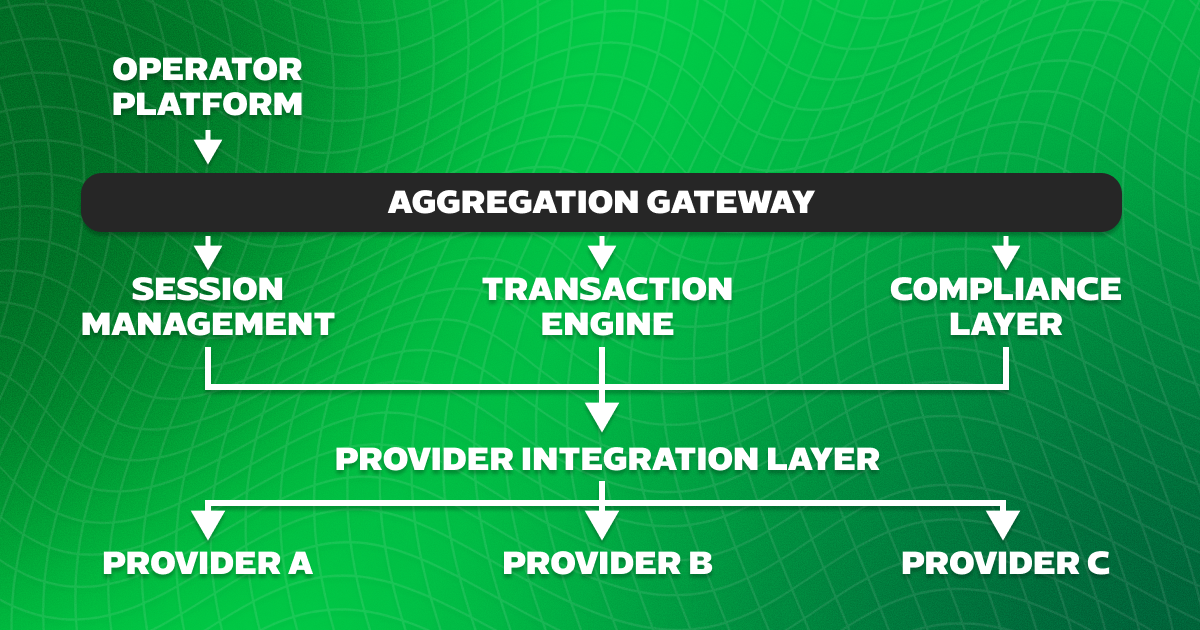
The diagram illustrates the internal architecture of a casino aggregation platform, including the gateway layer, transaction engine, compliance controls, and provider integration layer used to connect multiple game providers through a unified infrastructure.
How casino aggregator architecture works (technical deep dive)
Internally, aggregation systems operate as distributed stateful environments spanning multiple infrastructure layers.
When a player interacts with a game, several systems must remain synchronized:
- operator wallet
- aggregation transaction engine
- provider game server
- session orchestration layer
Each transaction passes through a validation pipeline.
- The aggregator verifies that the session is active and authorized.
- The transaction is forwarded to the operator wallet to confirm financial validity.
- The aggregator records the transaction in its internal ledger.
- The transaction is confirmed with the provider.
This architecture ensures consistency even during failure scenarios.
Modern aggregation infrastructure typically operates across multiple geographic regions to reduce latency and ensure uptime.
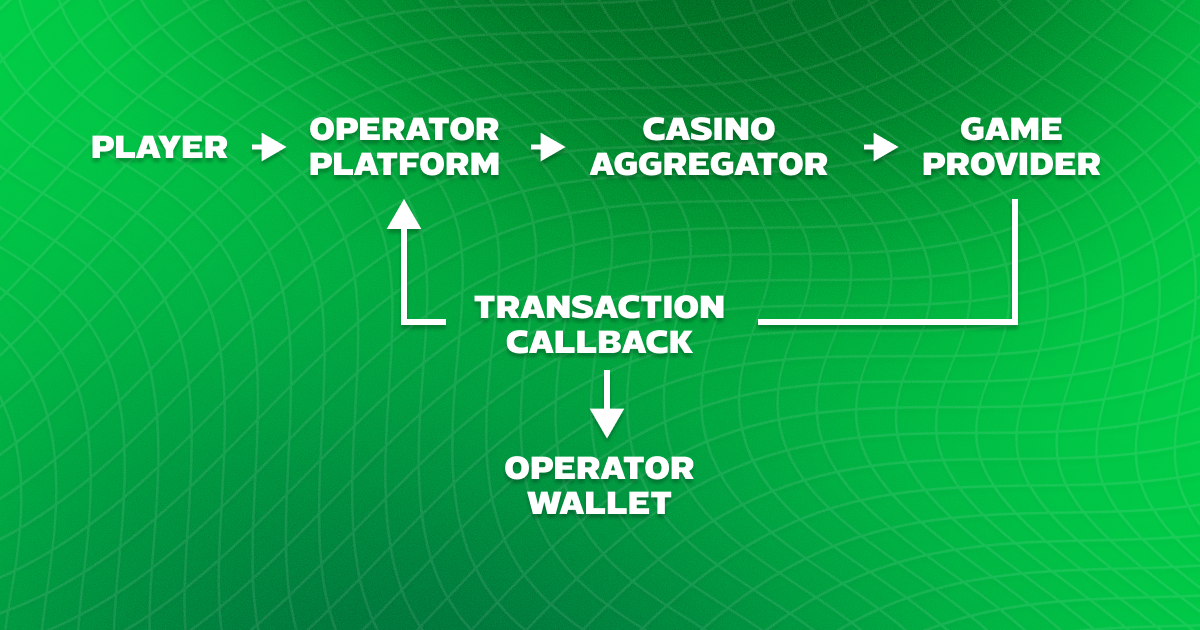
The diagram illustrates how a casino aggregator manages game session routing and transaction callbacks between game providers and the operator wallet infrastructure.
Seamless wallet vs transfer wallet
Wallet architecture determines how player balances are managed across providers.
In a seamless wallet architecture, the operator retains full control of player balances and all bets are processed directly against the operator wallet in real time.
In a transfer wallet model, funds are temporarily moved to a provider-controlled wallet during gameplay and reconciled afterward.
The seamless wallet model offers greater financial control, better balance consistency, and simplified reconciliation processes. For this reason, most modern operators prefer seamless wallet integrations.
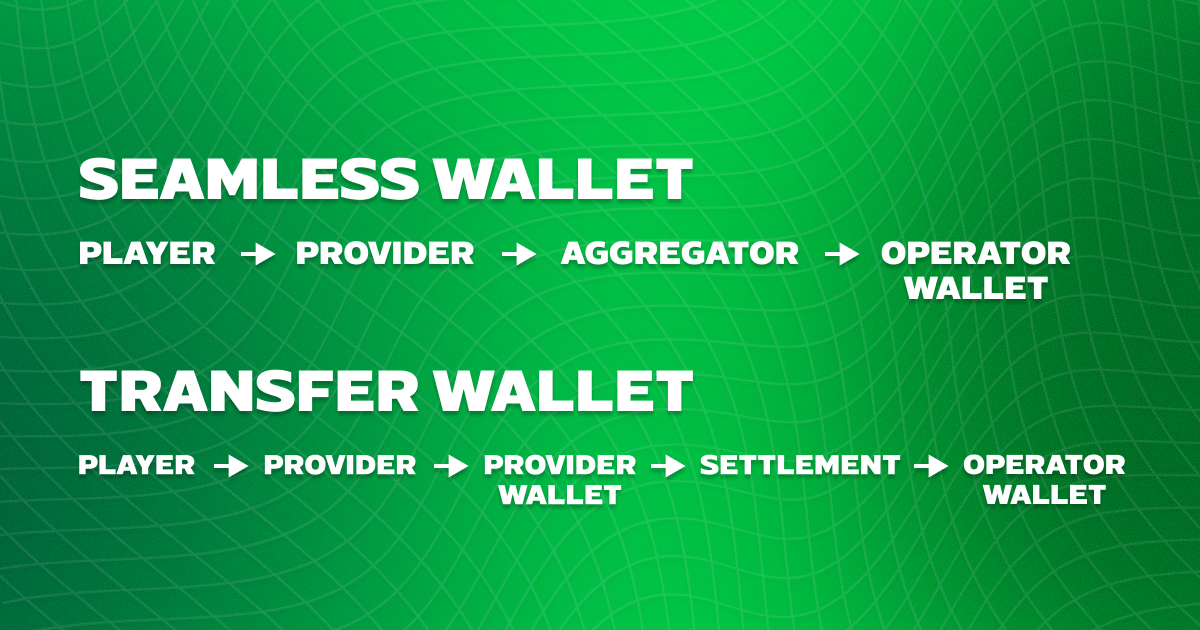
The diagram compares two wallet integration models used in iGaming platforms. In a seamless wallet architecture, all bets are processed directly through the operator wallet, while the transfer wallet model temporarily moves funds to a provider-controlled wallet during gameplay.
Benefits for operators
Aggregation significantly reduces engineering complexity by providing a single integration point for multiple providers.
Instead of maintaining numerous direct integrations, operators manage only one connection. This simplifies infrastructure maintenance, reduces operational risk, and accelerates content expansion.
Aggregation also allows operators to activate new providers quickly without major backend changes.
Standardized transaction handling improves platform stability and reduces the likelihood of financial inconsistencies.
Operational scalability also improves because the aggregation layer can handle increasing traffic without requiring structural changes to the operator platform.
Casino aggregator vs direct integration vs turnkey platforms
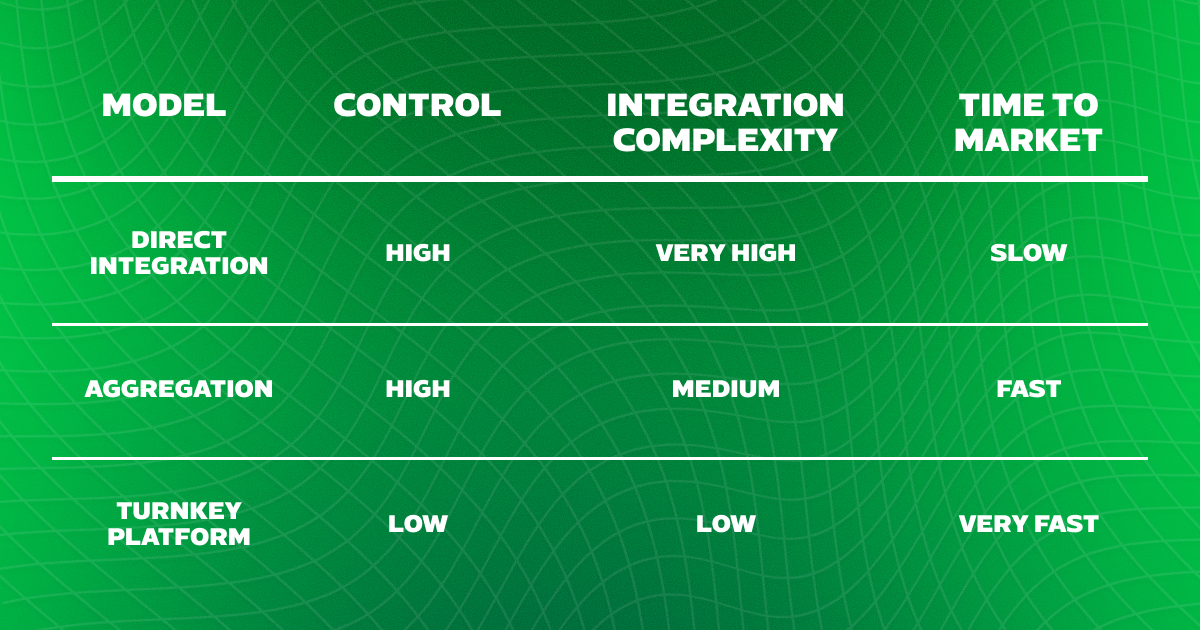
Online casino operators typically choose between three infrastructure models: direct integration, aggregation-based integration, or turnkey systems.
Direct integration provides maximum control but requires significant engineering resources and ongoing maintenance.
Aggregation simplifies provider connectivity by consolidating integrations into a single technical interface.
Turnkey platforms provide a fully operational environment that includes the backend system, wallet infrastructure, player management, frontend interface, and integrated game content.
Aggregation usually functions as a core component within turnkey architecture, enabling operators to access multiple providers without managing integrations themselves.
From an architectural perspective, aggregation and turnkey platforms complement each other rather than compete.
Common integration mistakes operators make
Integration failures rarely occur because of missing endpoints. Most problems arise from incorrect assumptions about how distributed financial systems behave under real production conditions.
Improper handling of idempotency is one of the most common issues. Network retries may deliver the same transaction request multiple times, and without safeguards duplicate financial events may occur.
Incomplete error handling is another frequent source of instability. Operators must correctly interpret asynchronous responses and ensure that wallet balances remain consistent even during temporary failures.
Session lifecycle management also introduces challenges because session state must remain synchronized across multiple systems.
Successful integration requires treating the aggregation layer as part of the operator’s financial transaction infrastructure.
What to look for in a casino aggregator platform
The aggregation layer becomes a critical component of the operator’s platform and participates in every financial transaction generated by gameplay.
A well-designed aggregation platform ensures deterministic transaction behavior and allows operators to trace each financial event across systems.
Transaction traceability supports auditing, dispute resolution, and operational monitoring.
Interface stability is also essential. Stable integration specifications allow operators to maintain long-term compatibility as infrastructure evolves.
High-quality aggregation platforms provide testing environments that simulate real transaction flows and allow operators to validate integrations before launch.
How aggregators ensure uptime and failover
Aggregation systems must operate continuously because even brief outages can disrupt thousands of active sessions.
To ensure resilience, aggregation infrastructure is deployed across multiple servers and geographic regions. Traffic is distributed across nodes to eliminate single points of failure.
Failover mechanisms automatically reroute requests when infrastructure components fail.
Persistent transaction logs allow systems to reconstruct transaction state during recovery scenarios.
Production aggregation environments typically maintain transaction latencies measured in tens of milliseconds.
Integration process
Integration with an aggregator begins with establishing secure communication between the operator platform and the aggregation infrastructure.
After authentication setup, operators integrate wallet transaction endpoints that allow the aggregator to request balance updates during gameplay.
Game launch integration follows, enabling the operator platform to initiate game sessions through the aggregation system.
Testing is essential to confirm that transaction flows, retry logic, and reconciliation mechanisms behave correctly.
Depending on platform readiness, integration typically takes between four and twelve weeks.
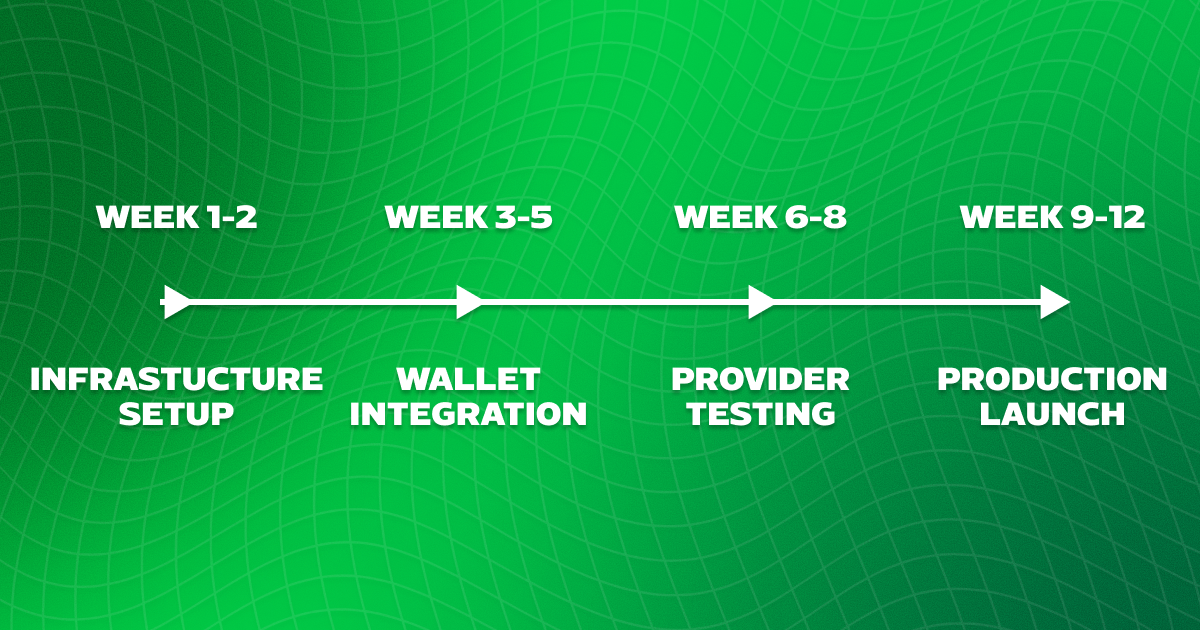
The diagram illustrates a typical integration process between an operator platform and a casino aggregation system. It includes infrastructure preparation, wallet integration, provider testing, and production launch stages that typically occur during a four to twelve week implementation cycle.
How aggregation impacts revenue
Aggregation affects revenue through improved content availability, infrastructure reliability, and faster market expansion.
Access to a broader portfolio of providers increases player engagement and session duration.
Infrastructure stability protects revenue by preventing transaction failures and gameplay interruptions.
Aggregation also reduces engineering overhead, allowing teams to focus on product development and market growth.
FAQ
How long does casino aggregator integration take?
Most integrations take between four and twelve weeks depending on wallet architecture, platform readiness, and testing requirements.
Do aggregators control player funds?
No. In seamless wallet architecture, the operator retains full control over player balances.
Can aggregators affect platform performance?
Yes. Aggregators directly influence transaction latency and platform reliability. High-quality systems maintain low latency and high uptime.
Is aggregation required for scaling a casino platform?
Aggregation is not strictly required but significantly simplifies scaling and provider expansion.
How many providers can a casino aggregator support?
Modern aggregation systems can support dozens or even hundreds of providers through a single integration.
Can aggregation support turnkey platforms?
Yes. Aggregation is a core component of most turnkey systems because it connects the platform to multiple game providers.
How does a casino aggregator integrate with operator wallets?
Integration usually relies on callback-based transaction processing. When a bet or payout occurs, the provider sends a request to the aggregator, which forwards debit or credit callbacks to the operator wallet.
Does using an aggregator reduce operational risk?
Yes. Aggregation reduces operational risk by centralizing provider integrations, transaction routing, and reconciliation logic into a single infrastructure layer.
Why casino aggregators became industry standard
Over the past decade, the iGaming industry has shifted toward aggregation as the dominant integration model for casino platforms. As the number of game providers grew rapidly, maintaining direct integrations with each studio became increasingly complex and resource-intensive.
Aggregation platforms emerged as a scalable solution that standardizes provider communication and simplifies infrastructure management. Instead of maintaining dozens of separate integrations, operators connect to a single system that manages provider connectivity, transaction routing, and session orchestration.
This architectural model significantly reduces development effort while enabling rapid content expansion. It also improves operational stability because transaction handling, reconciliation logic, and compliance enforcement are centralized within a dedicated infrastructure layer.
As a result, aggregation has become the industry standard for operators seeking to scale content portfolios and maintain reliable platform performance.
Conclusion
BCRAFT provides an enterprise-grade casino aggregation platform designed as production-grade infrastructure for online casino operators and turnkey platforms.
The platform enables operators to connect multiple game providers through a single integration while maintaining full control over wallet logic, player management, and backend architecture.
The system is designed to support scalable growth, reliable transaction handling, and long-term infrastructure stability.
Organizations evaluating aggregation solutions can explore how this infrastructure supports provider connectivity, operational reliability, and platform scalability.
Subscribe to our weekly newsletter
Get the latest insights, guides, and platform updates delivered straight to your inbox